Railways by Wolmar Christian;
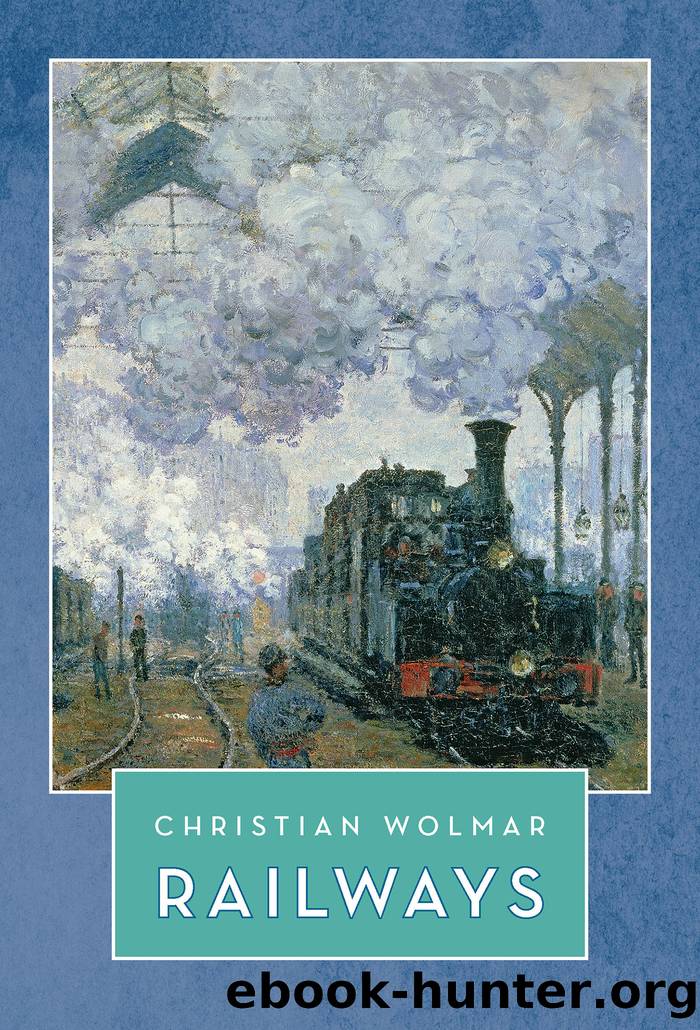
Author:Wolmar, Christian; [Wolmar, Christian]
Language: eng
Format: epub
Tags: The Landmark Library
Publisher: Head of Zeus
The railways played a key role in the four-year-long American Civil War, during which nearly all the fighting took place near stations or junctions. The second Battle of Bull Run, in 1862, wrecked the nearby station at Manassas Junction.
Buyenlarge / Getty Images
While this episode helped military strategists understand that railways could play a key role in the logistics of conflicts, it was the American Civil War, fought between 1861 and 1865, which demonstrated unequivocally that the railways would change forever the way wars would be waged in the future. The 400 battles of the Civil War, effectively one for every four days of the four-year conflict, took place over an area the size of Europe. Many of these encounters were fought in sparsely populated localities, which was only possible because they could be accessed by rail. The railwaysâ ability to move troops, matériel and supplies rapidly across long distances rendered the war bloodier, longer and more destructive than it would have been had it taken place a couple of decades previously. Throughout the Civil War, nearly all the crucial battles took place at railway junctions or near railheads.
The importance of the railways, which were far better developed in the North than the South â a key factor in the defeat of the Confederacy â was recognized from the outset by both sides. Abraham Lincoln was quick to bring the Northâs railways under government control, which was to give the Union side a decisive advantage. The Confederatesâ victory in the first major land battle of the war, at Bull Run in Virginia, in July 1861, 20 miles (32 km) southwest of Washington, DC, was achieved because fresh troops were brought to the battleground on a small but strategically important railway line, the Manassas Gap Railroad, which they then extended after the battle. The Confederates, however, made the mistake of not taking over their railway companies, which greatly hampered their logistics as the private companies that owned them drove a hard bargain.
Exercising direct control over their lines, the Federal government appointed Herman Haupt, a former superintendent of the Pennsylvania Railroad, to head up a new bureau created by the US War Department to construct and operate military railways as well as organize the repair of those damaged by the conflict. Haupt, a graduate of West Point, the US military college, proved not only to be brilliant at building and rebuilding railroads but also set out clear rules for the operation of railways in conflicts. These included ensuring that railway personnel, rather than the military, ran the train services and set the timetable, and making sure that wagons were unloaded quickly and returned to depots so they could be reused: regulations that may seem obvious, but were to prove crucial in both the American Civil War and subsequent conflicts.
The construction and destruction of railways occupied much of the energy of the rival armies during the Civil War. If the South won the first battle of the Civil War thanks to the railways, the
Download
This site does not store any files on its server. We only index and link to content provided by other sites. Please contact the content providers to delete copyright contents if any and email us, we'll remove relevant links or contents immediately.
Whiskies Galore by Ian Buxton(42142)
Introduction to Aircraft Design (Cambridge Aerospace Series) by John P. Fielding(33240)
Small Unmanned Fixed-wing Aircraft Design by Andrew J. Keane Andras Sobester James P. Scanlan & András Sóbester & James P. Scanlan(32866)
Aircraft Design of WWII: A Sketchbook by Lockheed Aircraft Corporation(32380)
Craft Beer for the Homebrewer by Michael Agnew(18336)
Turbulence by E. J. Noyes(8185)
The Complete Stick Figure Physics Tutorials by Allen Sarah(7469)
The Institute by Stephen King(7144)
The Thirst by Nesbo Jo(7083)
Kaplan MCAT General Chemistry Review by Kaplan(7044)
Bad Blood by John Carreyrou(6719)
Modelling of Convective Heat and Mass Transfer in Rotating Flows by Igor V. Shevchuk(6526)
Weapons of Math Destruction by Cathy O'Neil(6453)
Learning SQL by Alan Beaulieu(6394)
Man-made Catastrophes and Risk Information Concealment by Dmitry Chernov & Didier Sornette(6197)
Permanent Record by Edward Snowden(5944)
Digital Minimalism by Cal Newport;(5907)
Life 3.0: Being Human in the Age of Artificial Intelligence by Tegmark Max(5677)
iGen by Jean M. Twenge(5500)
